
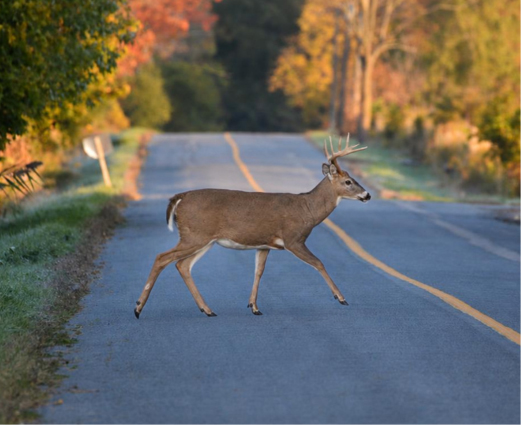
As autumn settles in and daylight hours shorten, seasonal shifts bring a sharp rise in road hazards. Reduced visibility, slick fallen leaves, and peak deer mating season combine to make late October through November one of the most dangerous stretches of the year for drivers.
Animal collisions, animal-related swerving accidents, and seasonal weather disruptions frequently lead to costly auto insurance claims. Understanding how fall driving risks impact your vehicle, safety, and policy coverage helps protect your family and financial well-being on the road.
The Perfect Storm: Mating Season Meets Shorter Days
The period between October and December marks the peak of the annual deer rut, when animals are active, unpredictable, and constantly moving across rural and suburban roads. This surge in deer movement directly coincides with the end of daylight saving time, shifting dusk into peak evening commuting hours.
When dusk falls right as traffic builds, visibility drops dramatically. Drivers face a narrow window of reaction time when a deer leaps into the roadway, making collision avoidance significantly harder.
Critical On-Road Maneuvers: What to Do When Deer Appear
When a deer suddenly appears on the road ahead, instinct tells most drivers to jerk the steering wheel. However, swerving to avoid an animal is often far more dangerous than hitting it.
Navigating the Split-Second Choice
- Brake Firmly and Hold the Wheel: Press the brakes hard in a straight line, hold the steering wheel firmly with both hands, and remain in your lane. Modern anti-lock braking systems (ABS) allow vehicles to stop efficiently without losing directional stability.
- Never Swerve into Other Lanes: Swerving takes your vehicle into oncoming traffic or off the shoulder into trees, guardrails, and ditches. Insurance claim data consistently shows that swerving crashes result in significantly more severe injuries and total vehicle losses than direct animal impacts.
- Assume Others Are Following: Deer rarely travel alone. If one deer crosses the road, assume two or three more are right behind it, waiting to leap into traffic.
- Use High Beams Strategically: On unlit rural or suburban roads, activate high beams whenever there is no oncoming traffic. High beams illuminate eye-shine from animals along the wood line well before they step onto the asphalt.
Secondary Fall Driving Hazards
Animal movements are not the only threat drivers face during autumn. Changing weather and foliage introduce subtle environmental risks that catch even experienced drivers unprepared.
| Hazard Type | Road Condition | Safety Impact | Recommended Driver Action |
| Wet Leaves | Decaying wet leaves forming a slick layer on asphalt | Reduces tire traction equivalent to driving on ice or hard-packed snow | Slow down on tree-lined curves, extend stopping distances, and avoid sudden braking. |
| Sun Glare | Low-angle sun during morning and evening commutes | Temporarily blinds drivers, hiding brake lights and crossing animals | Keep windshields clean inside and out, wear polarized sunglasses, and drop sun visors early. |
| First Frost | Morning frost on elevated surfaces like bridges and overpasses | Causes sudden loss of control on seemingly clear roads | Maintain steady speeds, avoid cruise control in cold mornings, and brake early before bridges. |
How Auto Insurance Responds to Autumn Accidents
Vehicle collisions caused by fall hazards trigger different parts of your auto policy depending on how the incident occurs. Reviewing your policy structure before an accident happens ensures your coverage aligns with your expectations.
Comprehensive Coverage for Animal Strikes
Direct physical impact with a deer, turkey, or other animal falls under Comprehensive Coverage (often called Other Than Collision). This coverage pays for repairs to your vehicle minus your selected deductible. Because comprehensive claims are classified as non-fault events, they typically have a milder impact on your future premium rates compared to moving violations or driver-at-fault accidents.
Collision Coverage for Swerving & Secondary Impacts
If a driver swerves to miss a deer and strikes a guardrail, telephone pole, or another vehicle, the event is classified as a Collision Claim. Because the driver lost control or left their lane, collision claims are usually treated as at-fault incidents, which can trigger premium surcharges at renewal and require payment of your collision deductible.
Glass & Emergency Roadside Endorsements
Striking a large animal often shatters windshields or disables the vehicle entirely. Adding full glass coverage eliminates out-of-pocket costs for windshield replacements, while roadside assistance guarantees towing support if your car becomes undriveable on a dark rural road.
Review Your Auto Policy Details
Seasonal roadway hazards can cause unexpected damage and costly repairs. Taking time to verify your comprehensive deductible, rental car reimbursement limits, and roadside assistance coverage before peak deer season helps keep your vehicle fully protected.
Contact our agency to review your current auto insurance policy details or update your coverage limits for the season ahead.
Recent Comments